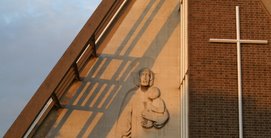
The Bishop of Lichfield has entered the debate about the right of Christians to wear crosses or fish badges while at work with a call for Christians to demonstrate that they “aren’t going to disappear quietly from the market place.”
In a pastoral letter published in November’s Parish Magazines across the Diocese of Lichfield, the Rt Revd Jonathan Gledhill says: “The Christian roots to our governance should not be nibbled away without discussion. Sometimes I think it wouldn’t be a bad thing if in December we all wore a fish badge or cross necklace and sent out a loud message that Christians aren’t going to disappear quietly from the market place or put away our crib figures in a hurry.”
But he also challenged Christians to demonstrate a far more costly sign than lapel badges and necklaces, saying: “The mark of a real Christian community is not so much the lapel badges and crosses we wear as the spontaneous, generous and practical love we show to the world. Christians should not be intimidated into putting away their neck crosses or lapel badges, but in the end these are not the badges that matter. The mark that matters is far more challenging.”
He said he had been reminded of this recently when he met two new Christians during a mission weekend in an urban parish in the diocese. He said: “both of them said that they had joined the church because they had come along as a result of a back-to-church Sunday invitation and similar and had been overwhelmed by the open welcome, the practical help and the sustained friendship they had received.”
In his letter, he says that companies’ decisions to sack those who want to wear a cross or fish lapel badge; and local councils deciding to rebrand Christmas out of fear of offending ethnic minorities are decisions made out of “sheer ignorance.” He says: “Ethnic minorities are far more anxious about the rampant secularism and commercialism that erodes all Christian standards than they are about their host country properly celebrating its Christian foundations.”
ENDS
What is the mark of the Christian?
A pastoral letter by the Bishop of Lichfield for November Parish Magazines in the Diocese of Lichfield
We’re just getting to the season when the papers like to report on local councils who, out of concern for ethnic minorities, have banned Christmas in favour of Winterval or another silly name. This year that kind of story is likely to be more than matched by stories of big firms sacking those people who want to wear a cross or a fish lapel badge or some other sign of the Christian faith. It is sheer ignorance of course.
Ethnic minorities are far more anxious about the rampant secularism and commercialism that erodes all Christian standards than they are about their host country properly celebrating its Christian foundations. No one goes to a Muslim country and expects local councils to silence the mosques out of sensitivity to Christians. The Christian roots to our governance should not be nibbled away without discussion. Sometimes I think it wouldn’t be a bad thing if in December we all wore a fish badge or cross necklace and sent out a loud message that Christians aren’t going to disappear quietly from the market place or put away our crib figures in a hurry (Though personally I am waiting for someone to invent a retractable fish badge before I put one on the back of the car — my driving is not always something to be proud of).
Recently I shared in a mission weekend in an urban parish in this diocese. The church had thrown open its doors to the wider community and schools, uniformed organisations and many others had come along to take part in the events. There was the wonderful atmosphere of a praying church at the heart of the community. During the Harvest Festival service on the Sunday two newish Christians were interviewed; both of them said that they had joined the church because they had come along as a result of a back-to-church Sunday invitation and similar and had been overwhelmed by the open welcome, the practical help and the sustained friendship they had received. I was reminded of another church and someone saying that they had come to faith because the joyful and self-giving way the people looked after the children in the Sunday School had so touched them that they knew God was real.
What I have discovered afresh this month is that the mark of a real Christian community is not so much the lapel badges and crosses we wear as the spontaneous, generous and practical love we show to the world. Christians should not be intimidated into putting away their neck crosses or lapel badges, but in the end these are not the badges that matter. The mark that matters is far more challenging.
Jonathan Gledhill
November 2009
Showing posts with label Bishop Jonathan. Show all posts
Showing posts with label Bishop Jonathan. Show all posts
Monday, 2 November 2009


Wednesday, 23 January 2008
Bishop Jonathan's Epiphany Message & Video
When Jesus was baptized by John, heaven opened to him, he saw the Spirit descending like a dove and God said: ‘This is my Beloved Son with whom I am well pleased’. It’s one of the most astonishing bits of the Good News that, before Jesus got stuck into his life’s work, before he did anything much for God, his heavenly Father did something for him and told him how much he loved him. In the same way, long before we start to serve and do things for God, our heavenly Father shows us that he loves us. Jesus himself is the definitive sign of how much we are loved, of course, and wherever Jesus is, in our churches for instance, there are signs for anyone who cares to look, that God loves us first.
Sometimes this happens in quite concrete ways and last year we had a rather exciting turn-around in our diocese. In 2002 we found that we were heading for bankruptcy. Particularly our larger churches had seen decline and children’s work was in free-fall. We had to take drastic action to cut clergy posts and reduce the budget by £800,000. Alongside that we focussed on a Strategy for Growth: praying that God would halt the decline and restore our church. Well, five years later, we can thank God for a wonderful confirmation of his love.
Last autumn we licensed the largest number of Lay Ministers that we can remember.
Back to Church Sunday produced several thousand returnees in church.
Parishes have appointed almost as many children’s workers as the number of clergy posts we have cut.
All those churches which have attended the Larger Churches course have stopped declining and started growing again.
Growth is happening in a large proportion of our parishes, including some of the poorest in the land.
We have been able to balance the budget, and strengthen our reserves.
We’ve decided to:
increase the number of stipendiary curates from 9 to 11 and
not to cut the last remaining three clergy posts of the 50 cuts agreed five years ago. We aim to stabilize the number of clergy and then pray for a gradual increase again.
We will reduce the annual increase in the Share Formula for the first time for many years.
We’ve even been able to offer stipendiary clergy health check-ups and we’ve begun a big programme so that every vicarage can have cavity wall insulation.
It is not all good news of course. Some parishes are struggling. But for every apparently insoluble problem we face there are encouragements and exciting opportunities. So I hope you will join with me at the beginning of a new year in giving thanks. Thank you to God for all the signs of his amazing grace, and thank you to all the faithful parishes where people have upped their giving and their commitment.
After Jesus was baptized and God confirmed his love for him he was ready to face the challenge of the next few years. And when we’ve been particularly loved by God, as we have, it helps strengthen us for what lies ahead.
Now there is a particular challenge coming for which I would value your prayers and your action.
We are going to need more clergy and especially more ordinands. We are just coming to the point over the next five years when the baby-boomer cohort of clergy is planning for retirement. Numbers of ordinands are up, but not yet enough to compensate for the expected number of retirements. Please pray that some of our clergy will retire a little later than at 65. And that we will be able to support more new ordinands each year, paid and voluntary.
It’s also important to pray for the increase in the number of Lay Readers and other voluntary lay ministers to be maintained.
And of course I’m praying for the money to train and pay for clergy and lay workers.
Jesus didn’t exactly know all the details of his coming ministry. But he knew he was loved and entrusted with the Good News. We don’t exactly know how things will be for our Diocese. But as we receive strength from God we will continue proclaiming the Kingdom, making new disciples, encouraging the ministry of the whole people of God, calling out ministries and using gifts, and increasing the number of ministers, lay and ordained.
I believe our aim should be to produce enough paid and voluntary clergy to staff as many parishes as possible. We should aim for high quality clergy, capable of forging ahead and giving leadership for different kinds of parish. Of course, we have to raise the money to pay for them. But a good stipendiary priest will soon pay for him/herself in all but the poorest parishes. Given the chance of a new vicar, most parishes will rise to the challenge of paying for him or her.
So the challenge this year, if we are continue the turn-around and provide for our churches, is not merely to do with the numbers of people coming through the doors of our churches but what happens to us as we walk out of the doors. All beloved sons and daughters have a ministry. My hope is that every parish will be encouraging every member to consider their calling and their ministry, because everyone is a beloved son or daughter. And out of all those callings my hope is that there will be some more from each place who will be given the gifts for ordained and lay ministry so that together we can be a sign of God’s love and grace.
For the last few years I have invited parishes to set aside Ash Wednesday or another suitable day as a day for concerted prayer and fasting for the Diocese. This year I invite you to do the same: first and most important to celebrate and thank the Lord for wonderfully giving us the security of his love; secondly to pray that the turn-around will become a steady growth, particularly in children and young people; and thirdly in prayer to the Lord of the harvest to provide the increase in ordinands, clergy and lay leaders we need for these next years.
And a joyful Epiphany to you all!
Jonathan Gledhill
Subscribe to:
Posts (Atom)